
It’s very common.
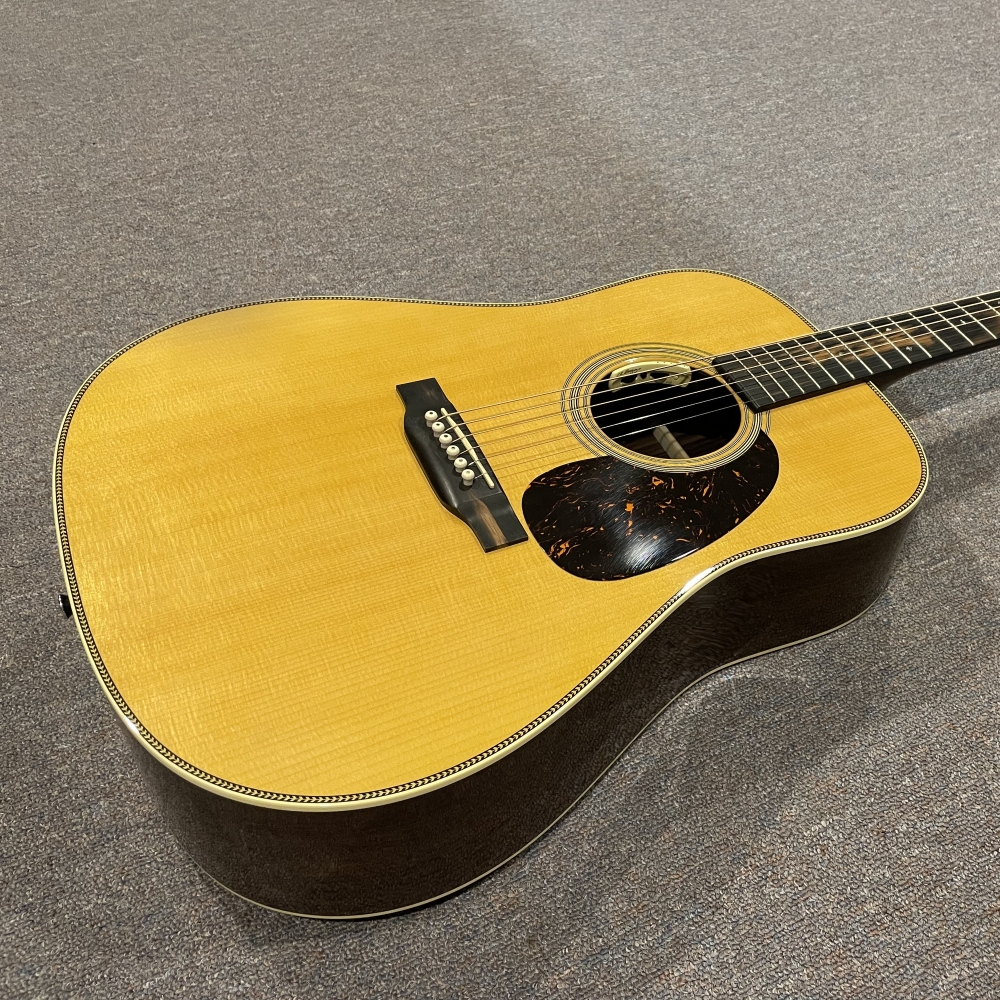
When we think about what an acoustic guitar looks like, most of us have a picture in our head that probably looks a lot like a Martin D-28. One reason it looks like a Martin D-28 is because it’s one of the most popular guitar body shapes out there and also one of the most versatile. This guitar is classified as a dreadnaught. So, what is a dreadnaught? Let’s find out.
A dreadnaught is a large bodied acoustic guitar designed to produce a lot of sound yet provide great bass response. It was first manufactured by Martin for the Oliver Ditson Company in 1916 and featured mahogany back and sides, a spruce top, various inlays, a rosette around the sound hole and a neck with a length of 12 frets to the body. A lot of these features still exist today. These initial guitars only lasted for four years after which the Oliver Ditson Company went out of business. The guitars did not sell well at the time as most people were used to playing smaller guitars. It would have appeared to be a little ahead of its time.
Martin released the D-1 Mahogany and D-2 Rosewood Dreadnaught guitars under their own name in 1931. Both were initially produced with a 12-fret-to-the-body neck design which later transitioned to a 14-fret-to-the-body neck in 1934. These guitars would become the D-18 and D-28. They became popular with country artists, complemented vocalists and fit in well musically with banjos and fiddles.
The Dreadnaught celebrated its 100th year anniversary in 2016 and Martin commemorated it with the release of the D-222. The commemorative D-222 was based on a D-111 pulled from their extensive collection. The original models built for Oliver Ditson Company included the D-111, the D-222 and the D-333 each a little fancier in appointments than the other.
Being one of the most recognizable guitars in the world is not a bad thing. Kudos to Martin for creating a legacy.